Last week, we brought together a small group of senior Operations and Transformation leaders from across the financial services sector for an invitation-only breakfast roundtable at the Scottish Financial Enterprise offices in Edinburgh. The premise was simple, if uncomfortable: acquisition-built organisations were never designed to work together as a single operation, and the resulting complexity is quietly making transformation harder, slower and more expensive than most leaders realise.
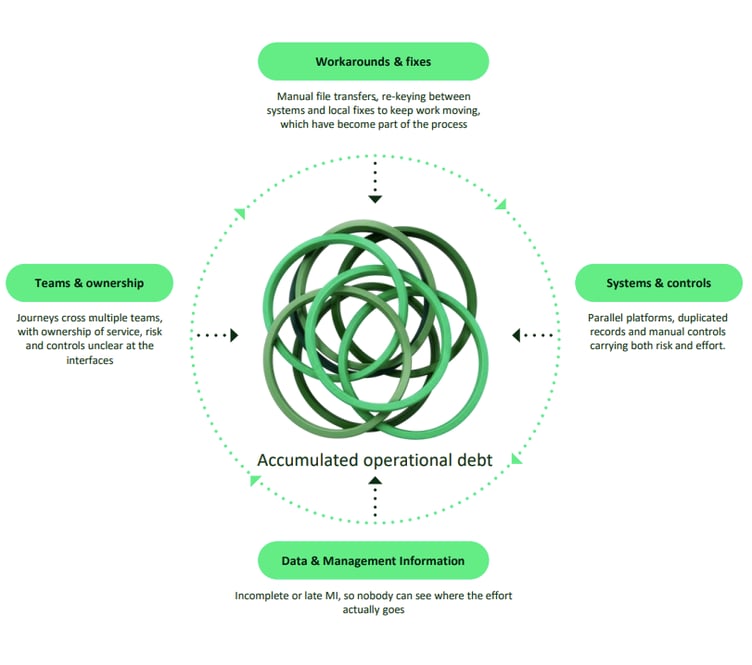
We opened the morning with a simple framing: that every acquisition brings with it an operational debt*, one that rarely gets priced into the deal and even more rarely gets paid down afterwards. It set the tone for what followed, one of the most candid discussions we've hosted on this topic. Six themes stood out.
1. Every acquisition adds to a debt nobody is measuring
The room agreed almost immediately: the commercial case for an acquisition gets modelled, scrutinised and approved in detail. What comes with it, the systems, the processes, the ways of working, rarely gets the same treatment.
As one participant put it, the cost of this operational debt is "broadly not understood until you get under the bonnet." Transformation and operations leaders are often not in the room when acquisition decisions are made, so this cost isn't factored into the deal at all. It simply gets inherited and absorbed into business-as-usual and skilled people quietly compensate for it through workarounds, extra effort and institutional memory.
That raised an obvious question the group kept circling back to: if you can't quantify operational debt, how do you ever prioritise fixing it? There was no consensus on a method, several felt this was one of the hardest problems in the room, but strong agreement that the absence of a measure is itself part of the problem.
2. Workarounds feel like progress, until the person who built them leaves
A recurring pattern emerged: skilled problem-solvers step in to make two operations function, building workarounds and manual fixes that get the job done. The organisation starts to rely on them. Then those people move on and take the knowledge with them.
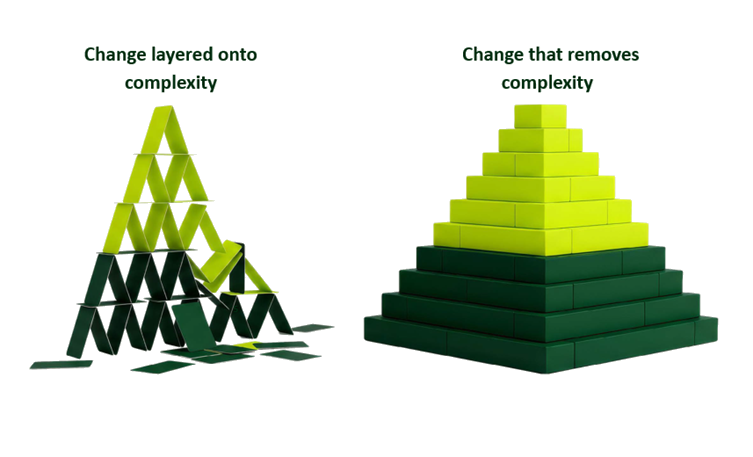
The house of cards image we'd used to introduce this risk found its own real-world version in the room: a client base built on trusted relationships lasting 20 years, held together by individuals who understood exactly how to navigate the organisation's inherited complexity. When those people left, the clients lost trust and left too. As another attendee noted, the tragedy is that departing experts often "don't even know they have that knowledge" — it's tacit, undocumented, and gone the moment they walk out the door.
This was framed as a genuine strategic risk, not just an HR issue: redundancies and attrition following an acquisition can strip out corporate memory long before anyone has worked out what needs preserving.
3. Culture and identity don't merge on their own
Several participants challenged the assumption that acquired businesses simply absorb into the acquirer. In practice, mergers can produce something genuinely new, but only if the work of building a shared identity is deliberate. Left unmanaged, the dominant organisation tends to impose its own way of working ("this is just how we do it here"), especially under pressure, regardless of good intentions at the outset.
Communication was repeatedly cited as the lever that determines whether this lands well: clarity, commitment, transparency and honesty were named as the non-negotiables. Get the comms wrong, and even a sound operating model will struggle to take hold.
4. Governance is often the first thing to break — and the first thing to fix
Governance came up more than almost any other topic. The frustration was consistent: good ideas get created, but oppressive governance and committee structures slow everything down. Merging two similarly sized organisations was singled out as particularly prone to paralysis — "nothing gets decided," as one attendee put it, when everyone is trying to keep everyone happy.
The group's advice was direct: be clear on governance from day one, empower single decision-makers where possible, and be willing to fail fast rather than seek consensus on everything.
5. Simplification has a shelf life — and it's shorter than people think
There was strong agreement that the best window to simplify is immediately after a deal closes. Once the initial energy of integration fades, appetite and budget for fixing the underlying technology and processes fades with it. As one participant summarised: "if Day 1 takes longer, it will avoid years of operational debt later."
The catch, of course, is that Day 1 activity is usually driven by urgency and a reasonable risk appetite to work from assumptions, on the understanding that teams will "go back and rectify" gaps later. The roundtable was candid that this rarely happens with the rigour it deserves. Lessons-learned exercises to make the next acquisition smoother were acknowledged as valuable in theory, but inconsistently taken seriously in practice.
6. Simplification is often talked about more than it's practised
Perhaps the most self-aware observation of the morning: organisations frequently pay lip service to simplification while behaviours tell a different story. Sales teams keep selling bespoke solutions. Teams keep building workarounds. New, standardised ways of working aren't given the authority, or the incentive, to stick.
Part of this tension is structural rather than a failure of will: there's a genuine mismatch between the standardisation the back office needs and the creativity the front office needs as markets and client needs shift. But part of it is also that due diligence tends to focus heavily on the market and the customer — which is relatively easy to assess — and far more lightly on the "detailed plumbing" underneath, which is where the real complexity, and the real cost, actually sits.
Where does this leave leaders?
There was no appetite in the room for a single silver bullet, and no one pretended there was one. But a few practical priorities emerged consistently:
- Widen due diligence beyond commercial terms to properly assess operational and technology complexity before a deal completes.
- Get governance and technology decisions right early, rather than deferring them in the name of deal speed.
- Treat corporate memory as a risk to be managed, particularly around redundancy and attrition following a deal.
- Invest deliberately in culture and comms, rather than assuming integration will happen by osmosis.
- Find a way to quantify operational debt — even an imperfect measure is better than none, and it's the only way to get it taken as seriously as revenue in decision-making.
There was also cautious optimism about the role AI can play — several participants noted its growing usefulness in rapidly assessing current-state operations, pulling together fragmented documentation, SLAs and client information that would otherwise take months to map manually. Legacy IT and data quality remain the binding constraint, but the direction of travel is encouraging.
Our thanks
Our thanks to the senior leaders who gave their time and spoke so openly yesterday morning. Discussions like this only work because people are willing to be candid about what hasn't worked, not just what has — and this group was exactly that.
If this discussion resonates with challenges in your own organisation, we'd welcome the conversation. Our latest executive paper, The Hidden Operational Complexity of Acquisition, explores these themes in more depth.
Reinvigoration hosted this executive roundtable, "Simplify to Survive," in Edinburgh in September 2026, bringing together senior Operations and Transformation leaders from across the financial services sector.
*Operational debt: the accumulated complexity created by historical decisions, workarounds and local optimisation that makes an organisation harder to operate, change and scale.